
TOM DUCAROUGE’S BAR NOMO
Shiro Kuramata is one of the designers who inspired us to start Pale Blue, so seeing his Miss Blanche chair reimagined for a Paris restaurant was an easy way to get our attention. Tom Ducarouge designed the interior of Bar Nomo, his first restaurant project, and everything in it started with that chair. The idea came from owner Arthur Cohen, a friend and client Tom had already designed chairs for at Baron next door. From there, Tom built out a whole material language of flowers, deep red cherry wood, and cast bronze.
The chairs are resin with flowers set inside, on solid cherry legs from L’Atelier du Renard. Tom cast them locally with Atelier Roma so he could compose the flowers himself. They worked from two molds at about two chairs a week, and the full run of chairs and tabletops took almost four months. Real flowers lost their color in the resin and dried flowers never gave the right effect, so he used detailed artificial flowers that are nearly impossible to tell from the real thing once cast. It’s a small detail, but Kuramata used artificial roses in Miss Blanche too.

William Guillon has been a favorite of ours for a long time, and it’s great to see his bronze in a space like this. Tom built the rectangular structure for the pendants over the bar and handed it off to William, who worked onto it in wax before casting his pieces in bronze. Tom’s clean geometry and William’s more organic, baroque hand balance each other out, and his patinas bring a warmth the room needs.
The use of red is our favorite part of the project, and it carries through every custom piece. Lamps, handles, vases, and shelves were all designed specifically for the space. Tom comes from industrial design and approaches a space through its objects, and that attention to every piece is what makes Bar Nomo so special. Next up is a Paris store for a Japanese brand, and we can’t wait to see it.
Read the full interview with Tom below.

Bar Nomo is your first restaurant project, and you designed everything from the overall space down to the chairs, lamps, handles, vases, and shelves. How did the project come about, and how did you land on that language of flowers, deep red wood, and bronze?
Bar Nomo is my first complete restaurant interior. The project came through Arthur Cohen, a friend and client who had previously asked me to design chairs for his restaurant Baron. A year later he invited me to take on the space next door, which became Bar Nomo.
The project started with a shared reference: Shiro Kuramata’s Miss Blanche chair. We wanted to pay tribute to it through resin chairs embedded with flowers, and that became the starting point for the entire interior. From there we developed a vocabulary of deep red wood, warm bronze, and lighting inspired by traditional pool-table lamps.
Craftsmanship is central to my practice, so I wanted to bring different techniques and makers into the project. That’s also why we collaborated with William Guillon: I was looking for a warm metal finish, and his approach to patinated bronze fitted the space perfectly.
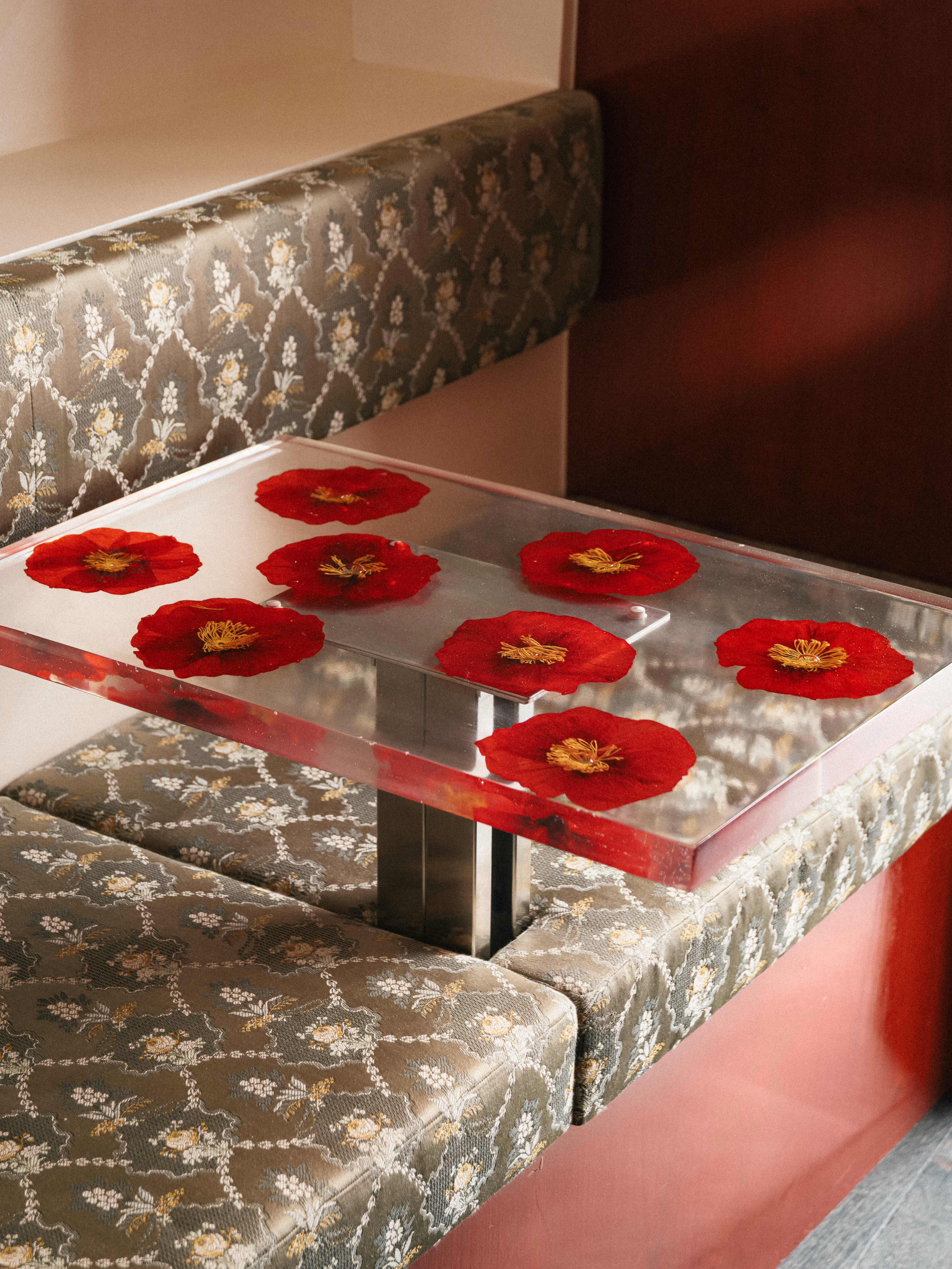
The chairs started the whole thing, an homage to Kuramata’s Miss Blanche in flower-embedded resin with solid cherry legs. How are they actually made? We’d love to hear about the process with Atelier Roma and L’Atelier du Renard, and how you approached translating such an iconic reference.
The chairs were probably the most time-consuming part of the project. After finalising the design and producing an initial prototype, we wanted to manufacture them locally so we could be closely involved throughout the process, particularly in composing the flowers inside the resin.
We worked with David Roma in the Paris region, developing two moulds that allowed us to cast 2 chairs every 7-8 days. Producing the full series of chairs and tabletops took almost four months.
During our tests, we discovered that real flowers lost their colour in the resin, while dried flowers didn’t give us the visual effect we wanted. We eventually chose detailed artificial flowers, which become almost impossible to distinguish from real ones once embedded in the resin. The solid cherry-wood legs were produced separately with L’Atelier du Renard.

The bronze details throughout, the lamps especially, came from William Guillon. How did that collaboration come about, and what did his bronze bring to the space?
What interested me about collaborating with William was the contrast between our formal languages. My work tends to be linear and constructed, while his is more organic and baroque. The lights above the bar combine those two approaches and create an interesting balance.
I designed and built the initial rectangular pendant structure, then gave it to William so he could work directly onto it in wax before casting his elements in bronze. His patinas brought the warmth and irregularity I was looking for against the more precise geometry of the space.

You trained at Central Saint Martins and have worked with Gucci, Rimowa, and Louis Vuitton on the industrial side. How does that background shape a project like this, and what’s next for the studio?
I see design as a continuous journey where every project introduces a new craft, technique or set of constraints. My background in industrial design has given me a very object-driven approach, even when I’m designing an entire space.
The last 2-3 years the studio focused mainly on furniture and temporary environments. Over the past month, we’ve started applying the same approach to permanent spaces, particularly retail and hospitality. Bar Nomo is the first of these projects to open and we’re currently working on several others, including a Paris store for a Japanese brand.
Going forward, I want the studio to maintain that balance between objects and spaces, and between strong concepts and the specific context of each project.
Photography by Adrien Ozouf
